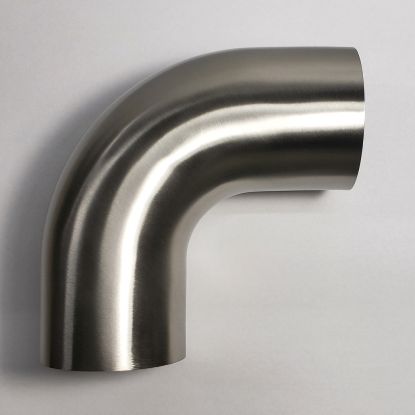

Stainless Bros 1.75in Diameter 1.5D / 2.62.0in CLR 90 Degree Bend 6.5in leg/6.5in leg Mandrel Bend
stb601-04556-8150
Stainless Bros 1.75in Diameter 1.5D / 2.62.0in CLR 90 Degree Bend 6.5in leg/6.5in leg Mandrel Bend
$366.03 excl. VAT
Missing the right angle to route your exhaust around the underbody, axle or fuel tank? This category brings together mandrel-bent bends in 45, 90 and 180 degrees for you who build or modify an exhaust yourself and need to weld the piping together.
With mandrel bending, the tube is supported from the inside during bending, so the diameter is maintained throughout the entire bend. This typically gives a smoother gas flow than a crush bend, where the cross-section is narrowed. The bends are welded together with straight exhaust tubing and, if needed, exhaust flanges, so you can route the exhaust exactly where there is room. Stainless Bros, for example, offers bends with and without legs – a straight tube section at the end that gives room to fit and weld.
The bend must suit both the routing and the rest of the system:
Tack the entire routing and check the ground clearance before you finish welding. Stainless steel and especially titanium are typically welded with back purging using shielding gas to avoid oxidation. Close to the engine, a flex pipe can absorb engine movement so the bends and welds are not stressed unnecessarily.
The number indicates the bend's radius relative to the tube's diameter. A 1D bend is tighter and takes up less space, while 1.5D is looser and typically gives a smoother flow. The choice depends on how much room there is.
SS321 is stabilised with titanium and is typically used where temperatures are high, e.g. close to the exhaust manifold. SS304 is often used further back. Also check which material the rest of the system is made of before you weld.
Pie cuts give you the freedom to build exactly the angle and routing that a ready-made bend does not cover, especially in large diameters. On the other hand, they require more welds and careful fitting of each segment.