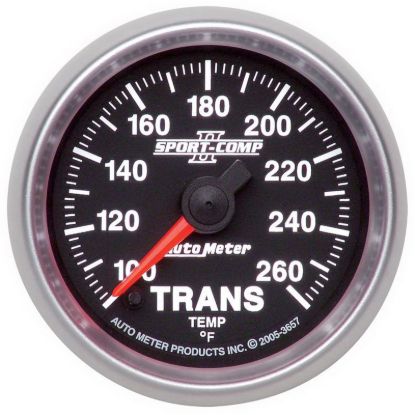

2-1/16" TRANS TEMP, 100- 250`F, SSE, GS
atm3849
Autometer GS 52mm 100-250 Degree F Short Sweep Electronic Transmission Temperature Gauge
$142.98 excl. VAT
Do you want to know exactly how hot your engine, oil or gearbox gets during hard driving? Temperature gauges continuously show coolant, oil, transmission or exhaust gas temperature, so you can react in time to the first signs of overheating. They are for you if you are building a project car or doing track days.
The category covers gauges for coolant, engine oil and transmission as well as pyrometers for exhaust gas, e.g. an AutoMeter Z-Series with a scale up to 1600 °F. Coolant and oil tell you whether the engine is working within its normal range, while transmission temperature is relevant under heavy load. If you also measure air-fuel ratio, you will find wideband AFR gauges in a sister category, and all individual gauges are gathered under individual gauges.
Check that the sensor's thread and length suit the location in the engine, oil system or gearbox, and that sender and gauge belong together. A capillary tube must not be kinked or pinched. If you want a uniform dashboard, you can combine with oil pressure gauges and voltmeters from AutoMeter.
It depends on your car and installation. A mechanical gauge typically requires the capillary tube to be routed all the way to the gauge, while an electronic gauge uses a sender and wiring, which are often easier to position.
A pyrometer measures exhaust gas temperature. It can be used to monitor the load on the engine, e.g. during tuning or hard driving, where high gas temperatures can be a sign that something should be adjusted.
The location depends on the engine and oil system, e.g. in the oil pan, an adapter at the oil filter or the oil cooler circuit. Check the thread and sensor length for the specific part number before installing.